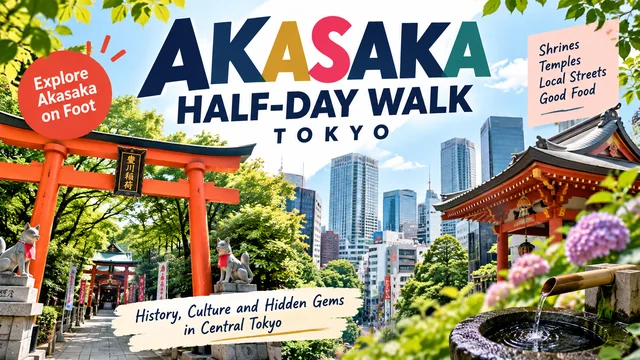
What comes to mind when you think of Akasaka?
Perhaps TBS and Akasaka Sacas, the hotels around Akasaka-mitsuke, or the seemingly endless choice of restaurants and bars. For international visitors, Akasaka is also a convenient and familiar place to stay in central Tokyo.
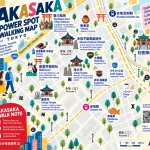
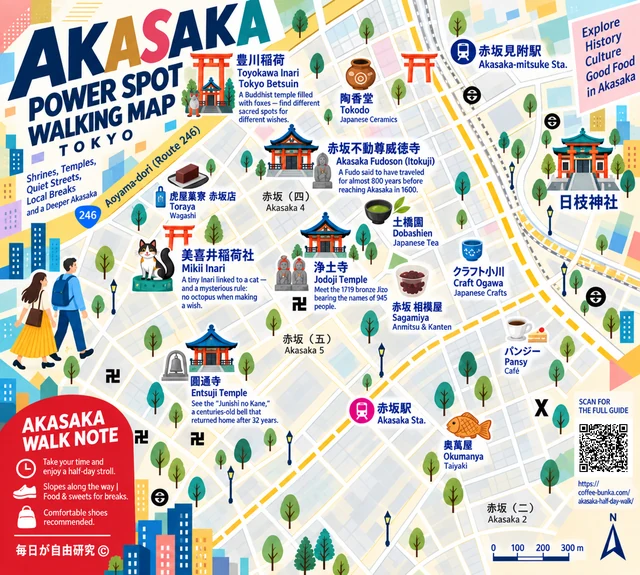
Click the map to view or print the full A4 PDF.
But step away from the main streets, and a very different Akasaka begins to appear.
There is a tiny Inari shrine associated with a cat — and a mysterious warning telling worshippers not to eat octopus. There is a Buddhist image said to have been cast into the sea, only to emerge from the waters off Niigata more than half a century later. There is an Edo-period Jizo bearing the names of 945 people. And there is an old temple bell that disappeared during World War II, only to be discovered at another Tokyo temple 32 years later and eventually returned home.
All of them can be visited on foot in central Akasaka.
This is not a route for rushing from one famous attraction to another. Take half a day, stop for wagashi or Japanese tea, browse ceramics and traditional crafts, and discover a slightly mysterious side of Akasaka.
1. Toyokawa Inari Tokyo Betsuin — An “Inari” That Is Actually a Buddhist Temple
Let’s begin near Aoyama-dori at Toyokawa Inari Tokyo Betsuin.
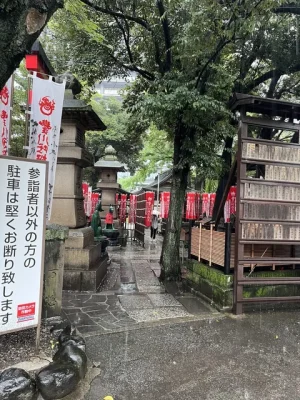
The word Inari usually brings to mind a Shinto shrine. But Toyokawa Inari is actually a Buddhist temple of the Soto Zen school. Its principal object of worship is Toyokawa Dakini Shinten.
The Tokyo temple also has a connection with one of the best-known officials of the Edo period: Ooka Tadasuke, often known as Ooka Echizen, the celebrated Edo magistrate who later became the subject of countless stories and television dramas.
According to Toyokawa Inari Tokyo Betsuin, the Ooka family deeply revered Toyokawa Dakini Shinten and enshrined the sacred image at their residence. In 1887, it was enshrined at the present location.
One of the pleasures of exploring the grounds is discovering how many different forms of devotion coexist within a single temple.
There is Kano Inari, associated with cleansing harmful ties and misfortune; Kodakara Kannon, where people pray for children; Daikokuten, associated with protection from misfortune and the bringing of good fortune; Migawari Jizo, the “substitute” Jizo believed to take misfortune in another’s place; and Aizen Myo-o, associated with love and good relationships. The Seven Lucky Gods can also be found around the grounds.
And everywhere, there are foxes.
An Inari that is not a Shinto shrine. A Buddhist temple filled with foxes.
Toyokawa Inari is a good place to experience how Japanese religious traditions do not always fit neatly into a simple division between “Shinto” and “Buddhism.”
It is by far the largest of the five places on this walk, with plenty to see. If you are following the full half-day route, it is worth keeping an eye on the time.
Reference
Toyokawa Inari Tokyo Betsuin, official website, “About Toyokawa Inari Betsuin”
https://www.toyokawainari-tokyo.jp/english/
2. Mikii Inari — A Cat, a Wish, and a Ban on Octopus
Mikii Inari could hardly be more different from Toyokawa Inari.
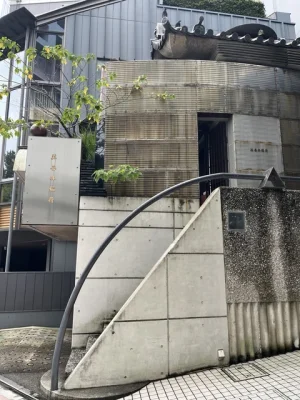
It stands along Dansho-zaka, but unless you already know it is there, it is remarkably easy to miss. A small flight of steps leads up to the tiny inari.
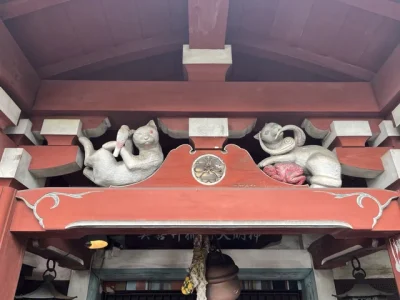
And this Inari has an unusual connection: a cat.
A documented local tradition tells of a person who was saved by a cat during a fire. The cat itself did not survive, and it was later enshrined and memorialized here.
That alone makes Mikii Inari unusual. Inari worship is overwhelmingly associated with foxes, yet here a cat is central to the story.
Then there is the notice at the inari.
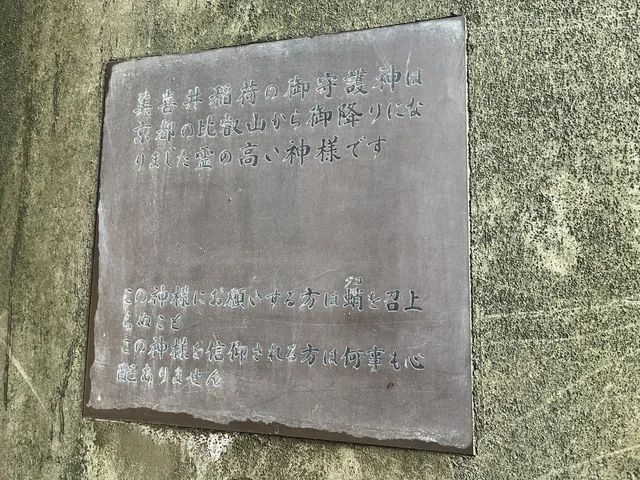
It tells those who make a request of the deity:
“Those who make a wish to this deity must not eat octopus.”
The notice can still be seen at the inari today.
Why octopus?
There is no definitive explanation in the sources I could confirm. It may have some connection with the cat tradition, or it may come from an entirely different belief.
The notice does not tell you how long the prohibition lasts, either. Does it apply only when making the wish? Until the wish is fulfilled? For as long as you worship here?
It does not say.
And perhaps that unanswered question is part of what makes this little shrine so memorable.
Another notice at the site describes its guardian deity as a spiritually exalted deity who descended from Mount Hiei in Kyoto.
Mikii Inari is not a major tourist attraction. That is precisely the point.
A few steps above an ordinary Akasaka street, in a place you could pass dozens of times without noticing, an old and still somewhat mysterious tradition involving a cat and an octopus taboo survives.
Reference
Hiroko Shibauchi, “Legends and Traditions Concerning Cats in Japan”
The paper discusses the cat tradition at Mikii Inari, the Mount Hiei tradition, and the notice prohibiting octopus. The reason for the octopus taboo remains uncertain.
https://akasaka-ah.com/html/upload/wp-content/blog/wp-content/uploads/2022/07/history.pdf
The octopus notice was also confirmed and photographed on site.
3. Akasaka Fudoson — A Buddhist Image Said to Have Traveled for 800 Years
Akasaka Fudoson, formally known as Itokuji Temple, stands just off Hitotsugi-dori.
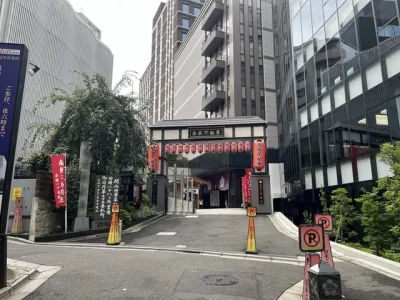
Looking at its present-day surroundings, it is difficult to imagine that the traditional story of its principal Buddhist image begins at sea more than 1,200 years ago.
According to Itokuji’s own temple legend, in 805, the Buddhist monk Saicho — founder of the Tendai school in Japan — was returning from Tang China when his ship encountered a violent storm.
With the vessel in danger of sinking, Saicho is said to have carved an image of Fudo Myo-o, the Buddhist deity often called the Immovable Wisdom King, and lowered it into the sea while praying for a safe voyage.
Then, in 858, 53 years later, a fisherman at Izumozaki in Echigo — present-day Niigata Prefecture — repeatedly saw a mysterious light shining over the sea at night. When the source was investigated, an image of Fudo Myo-o was said to have emerged from the water.
According to the temple tradition, it was the same image Saicho had placed in the sea in 805.
But the journey did not end there.
In 1051, the warrior Minamoto no Yoriyoshi is said to have prayed before the image for victory in battle. After experiencing its spiritual power, he had it moved in 1063 to Shimosa Yonezawa, in what is now Kozaki in Chiba Prefecture.
The temple tradition also records that Hojo Tokimune later prayed before the Fudo at the time of the Mongol invasions of Japan.
Then, in 1600, the temple priest Ryodai received what was believed to be a message from the Fudo in a dream, and the temple was moved to Hitotsugi in Akasaka.
Following the traditional account, the journey looks like this:
The sea (805) → Echigo (858) → Shimosa (1063) → Akasaka (1600)
A sacred image that, according to temple tradition, took almost 800 years to reach Akasaka.
During the Edo period, Itokuji became a prayer temple for the Kishu branch of the Tokugawa family. A miniature shrine and Buddhist implements donated by the family remain in the inner sanctuary, while the principal Fudo image continues to be kept as a hibutsu — a sacred image normally hidden from public view.
This does not mean that historians have established that the present image was literally carved by Saicho in 805. This is the traditional history preserved by Itokuji itself.
But knowing the story changes the way the place feels.
Between the modern buildings of Akasaka sits a Fudo said to have disappeared beneath the sea in 805, emerged off the coast of present-day Niigata in 858, traveled to present-day Chiba in 1063, and finally arrived in Akasaka in 1600.
Reference
Akasaka Fudoson Itokuji, official history
https://www.akasakaitokuji.com/engi
4. Jodoji Temple — A Jizo Bearing 945 Names
At Jodoji Temple, look for the large seated bronze Jizo.
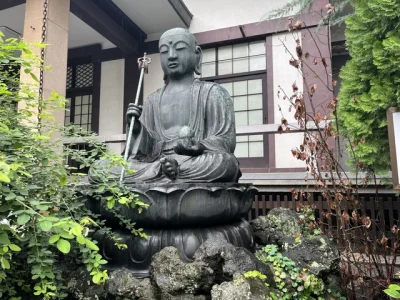
It dates from 1719 and stands approximately 1.3 meters high, holding a sacred jewel in one hand and a Buddhist staff in the other.
But its size is not the most remarkable thing about it.
Across the statue and its 50-centimeter-high pedestal are the names of 945 people — samurai, townspeople and others who participated in its creation through religious donations and devotion.
According to the Minato City Local History Museum, no comparable Jizo is known elsewhere in Minato City.
An inscription on its back identifies the caster as Ota Suruga-no-kami Masayoshi. He is believed to have been the same craftsman known as Ota Suruga-no-kami Masayoshi of Kanda Nabemachi, who cast the famous Edo Six Jizo.
One Jizo, carrying the names of 945 people from Edo.
Once you know that, it becomes difficult to see it simply as an old Buddhist statue.
Jodoji was also long known locally as “Roku Jizo-san” — “the Six Jizo temple.”
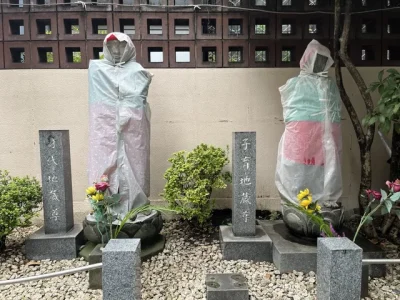
Do not, however, arrive expecting to find six identical Jizo statues standing in a row. Today, two stone Jizo can be seen near the entrance, with the much larger bronze Jizo farther inside.
Jodoji also carries a memory of wartime Tokyo.
According to a Minato City publication based on an interview with the temple priest, an incendiary bomb struck the main hall during the Tokyo air raids. As fire spread, an attempt was made to save the principal Buddhist image by placing it in a pond. Its head and hands were rescued and, according to the account, remain enshrined in the main hall today.
An Edo-period Jizo carrying 945 names, and a principal image partly rescued from the fires of war.
Jodoji is a quiet temple, but several centuries of Akasaka’s history survive within it.
At the Hitotsugi-dori entrance to the approach, you will also find two smaller Jizo on the right: Migawari Jizo, associated with protection from misfortune, and Kosodate Jizo, associated with children and child-rearing.
References
Minato City Local History Museum, “Seated Bronze Jizo Bodhisattva”
https://www.minato-rekishi.com/museum/2009/10/85.html
Minato City, Akasaka-Aoyama Community Information Magazine
Includes an interview with Jodoji’s priest and accounts concerning the name “Roku Jizo-san” and the temple during the wartime air raids.
https://www.city.minato.tokyo.jp/akasakachikusei/akasaka/koho/documents/akasaka21.pdf
5. Entsuji Temple — The Bell That Came Home
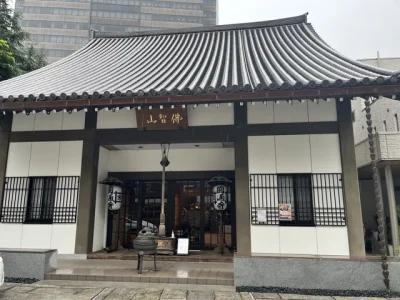
Our final temple is Entsuji.
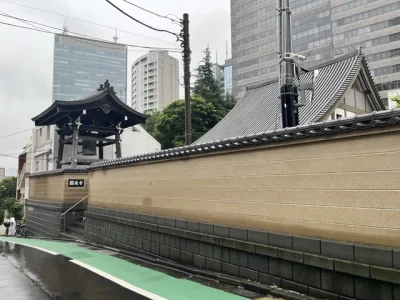
The object to look for here is a temple bell designated as a cultural property by Minato City.
In Japanese, it is known as the “Junishi no Kane” (十二支の鐘) — a bell inscribed with all twelve animals of the Chinese zodiac.
Why that name?
A seven-character Chinese poem inscribed on the bell incorporates all twelve animals:
Rat, Ox, Tiger, Rabbit, Dragon, Snake, Horse, Sheep, Monkey, Rooster, Dog and Boar.
Research by the Minato City Local History Museum suggests that the bell was cast sometime between the late 17th and early 18th centuries.
Until around the Horeki era (1751–1764), it served as a toki no kane, a bell rung to tell local residents the time.
Then, in December 1943, the bell was surrendered as metal for the war effort.
After that, its whereabouts were unknown.
It resurfaced in 1975, thirty years after the end of the war.
And it had not traveled very far.
The bell was found at another Buddhist temple in Itabashi, Tokyo.
Entsuji acquired it, and the Junishi no Kane finally returned to Akasaka.
It had left in 1943 and returned in 1975:
32 years away from home.
And this is not simply an old bell sitting silently as a museum piece.
It is still rung on New Year’s Eve.
A centuries-old bell disappeared during a war, survived at another temple somewhere else in Tokyo, returned to its original home decades later — and still rings today.
Entsuji is worth visiting just to know that story before you look up at the bell.
Reference
Minato City Local History Museum, “Entsuji Temple Bell”
https://www.minato-rekishi.com/museum/2018/11/post-3.html
More Than Temples: Small Akasaka Detours
The point of this walk is not to “complete” five spiritual sites as quickly as possible.
Between them are shops that make good reasons to slow down.
For traditional Japanese sweets, there are long-established names such as Toraya and Shiono. Sagamiya is a good stop for anmitsu, a traditional dessert of agar jelly and sweet red bean paste. Okumanya serves taiyaki generously filled with anko. At Dobashien, Japanese tea also appears in more contemporary forms such as lattes, while Pansy offers something increasingly valuable halfway through a walk: a chair, a table and time for a proper café break.
There is more to browse than food.
Around Hitotsugi-dori, Craft Ogawa carries Japanese ceramics, lacquerware, glassware, woodwork and other handcrafted goods. Nearby Tokodo, a long-established specialist in Japanese ceramics and tableware, is another easy place to browse for something made in Japan.
I have deliberately not selected lunch or dinner restaurants for this map.
Akasaka has far too many of them, and the right choice depends heavily on your budget and what you feel like eating that day.
Instead, the map concentrates on places that give you a particular reason to stop while exploring Akasaka.
In Akasaka, Distance Is Only Half the Story
There is something that becomes obvious only after walking around Akasaka:
distance on a map does not tell you how tiring a route will be.
This is a neighborhood of slopes.
Even two places that appear close together on a map can involve a surprisingly steep climb. Some apparently convenient walking routes also use long flights of stairs.
For this half-day route, I deliberately left out some historically interesting places when reaching them would require an unnecessarily steep detour, or where access involved a private road that would be awkward to recommend to visitors.
The aim is not to squeeze the maximum possible number of pins onto a map.
It is to make the walk enjoyable.
Shrines and temples can also be surprisingly difficult to locate from an address alone, particularly when the actual entrance is small or faces a different street.
For that reason, the places included in this walk were checked on foot.
A Half-Day Walk Can Change the Way Akasaka Looks
Start among the foxes of Toyokawa Inari, then climb the steps to a tiny shrine associated with a cat and an unexplained octopus taboo.
Continue to a Fudo said to have disappeared into the sea in 805, emerged in Echigo in 858, moved to Shimosa in 1063, and finally reached Akasaka in 1600.
Find an Edo-period Jizo carrying 945 names. Then stand beneath the Junishi no Kane, a bell inscribed with all twelve animals of the Chinese zodiac, which vanished during World War II and returned home 32 years later.
None of these places is a giant tourist attraction.
Some are easy to walk straight past if you do not know they are there.
But once you know their stories, another Akasaka begins to appear beneath the modern neighborhood of television studios, hotels and restaurants.
Buy a piece of wagashi along the way. Stop for tea. Browse a ceramic shop. Sit down when you feel like it.
There is no need to rush through everything.
Give Akasaka half a day, and see what you find.
The accompanying map is designed for exactly that kind of walk.
Download the Akasaka Half-Day Walking Map
This map was created after checking the route and locations on foot. Tap the preview below to open the full-size A4 map for viewing or printing.